The only US-distributed QC organism line manufactured exclusively from NCTC® and NCPF® source strains under licence from the UKHSA Culture Collections — first-generation discs, UKAS-accredited COA per lot, NCTC↔ATCC equivalents where applicable.
Get a Quote Download Insert + Sample COAPro-Cult® is the only US-distributed quality control organism line manufactured exclusively from NCTC® and NCPF® source strains under licence from the UKHSA Culture Collections. Each freeze-dried disc is a guaranteed first-generation subculture of the master strain — not a multi-passage derivative. Every batch is tested in UKAS-accredited Lab #2496 with an online Certificate of Analysis available per lot. Pro-Cult gives clinical, pharmaceutical, food, water, and veterinary labs a documented second-source alternative to ATCC-derived QC products, with NCTC↔ATCC equivalents listed where applicable.
Pro-Cult discs are freeze-dried microbial preparations manufactured exclusively from NCTC® and NCPF® cultures under a manufacturing licence held with the PHE/UKHSA Culture Collections — the European peer authenticated source to ATCC.
Source: Pro-Cult Insert Issue 10 (Sept 2019), Quality sectionEach Pro-Cult disc is the first-generation subculture from the NCTC/NCPF master strain, leaving you the full four-passage working-stock budget recommended by CLSI and ASM convention.
Source: Pro-Cult Insert Issue 10, Limitations sectionEvery batch is tested for identification and characterization attributes in UKAS-accredited Lab #2496. Pull the per-lot COA from the TCS Biosciences online portal by Code, Lot, Strain, or Strain Designation — no vendor email, no audit-day delay.
Source: Pro-Cult Insert Issue 10, Quality section; verifiable at ukas.comPro-Cult labels and COAs carry both the NCTC number and the ATCC equivalent where applicable, so your CLSI M100, EUCAST, and CAP IQCP SOPs need only an addendum line — not a rewrite.
Source: Pro-Cult Insert Issue 10, Quality sectionYou own the QC plan, the CAP audit, and the answer when a Microbiologics back-order hits a M100 cycle. Pro-Cult® is the only US-distributed QC organism line manufactured exclusively from the UKHSA Culture Collections (NCTC®/NCPF®), with first-generation discs, UKAS-accredited per-lot COA, and NCTC↔ATCC equivalences listed where applicable. Adopt it as your primary or as your second source — your IQCP plan and your inspectors will both thank you.
You're the one who actually opens the vial, plates the disc, and signs the lot release. Pro-Cult is built for that bench reality: each freeze-dried disc softens in 10–15 minutes for direct plating or dissolves in 1–10 mL of broth, every label shows both the NCTC and ATCC numbers, and the per-lot COA is one click away on the TCS Biosciences UKAS-accredited portal. Switching takes an SOP addendum and a 30-day parallel run — not a QC plan rewrite.
You don't need to switch formularies to add Pro-Cult®. We price-match your existing QC organism GPO tier on matched SKUs, ship from US fulfillment as UN3373 Cat. B refrigerated (no hazmat surcharge), and provide the ISO 13485:2016 and ISO 9001 manufacturer certificates, the ISO/IEC 17025 (UKAS Lab #2496) batch-testing accreditation, the NCTC/NCPF licence statement, and a supply-continuity SLA with the W-9 and credit application. Onboarding through your standard vendor process — no special procurement carve-out.
Your USP <61>/<62> growth promotion, USP <71> sterility method suitability, and Ph.Eur. 2.6.12/2.6.13 controls require authenticated, traceable QC organisms — and your supply-continuity audit increasingly requires a documented second source. Pro-Cult® is manufactured exclusively from NCTC® and NCPF® source strains under UKHSA Culture Collections licence, batch-tested in UKAS-accredited Lab #2496, with online COA per lot. Pair it with your ATCC primary, or run it as the redundant authenticated source your QA system has been asking for.
Compliance note: Pro-Cult is positioned as a QC organism material (lyophilized authenticated culture). It is not an ISO 17034 Certified Reference Material. Where your method explicitly requires CRM, source from an ISO 17034-accredited supplier. For routine growth-promotion, sterility-method-suitability, and inhibitory-substance testing where authenticated culture is acceptable, Pro-Cult is fit-for-purpose.
Request a Pharma QC QuoteThe 20 most-frequently-ordered Pro-Cult strains for CLSI M100 / EUCAST AST QC, USP <61>/<62>/<71> growth promotion, and FDA BAM-method positives. The full ~80-strain catalog covers 26 genera across clinical, pharma, food, water, and veterinary QC. Each NCTC↔ATCC equivalence is documented on the per-lot COA.
| Genus / Species | NCTC # | ATCC equiv. | Use case | |
|---|---|---|---|---|
| Escherichia coli | NCTC 12241 | ATCC 25922 | CLSI M100 / EUCAST AST QC reference | Quote |
| Staphylococcus aureus | NCTC 12973 | ATCC 29213 | CLSI M100 / EUCAST AST QC reference | Quote |
| Pseudomonas aeruginosa | NCTC 12903 | ATCC 27853 | CLSI M100 / EUCAST AST QC reference | Quote |
| Enterococcus faecalis | NCTC 12697 | ATCC 29212 | CLSI M100 / EUCAST AST QC reference | Quote |
| Klebsiella pneumoniae | NCTC 13368 | ATCC 700603 | CLSI M100 ESBL QC reference | Quote |
| Escherichia coli | NCTC 10418 | — | UK NHS routine media QC standard | Quote |
| Escherichia coli O157 (non-toxigenic) | NCTC 12900 | ATCC 700728 | FDA BAM Salmonella/STEC media QC | Quote |
| Salmonella enterica Typhimurium | NCTC 12023 | ATCC 14028 | FDA BAM XLD/Hektoen QC | Quote |
| Listeria monocytogenes | NCTC 11994 | — | FDA BAM Listeria selective media QC | Quote |
| Candida albicans | NCPF 3179 | ATCC 10231 | USP <61>/<62> growth promotion | Quote |
| Saccharomyces cerevisiae | NCTC 10716 | ATCC 9763 | USP <61>/<62> growth promotion | Quote |
| Aspergillus brasiliensis | NCPF 2275 | ATCC 16404 | USP <61>/<62> growth promotion | Quote |
| Bacillus subtilis | NCTC 10400 | ATCC 6633 | USP <61>/<62> growth promotion | Quote |
| Clostridium sporogenes | NCTC 532 | ATCC 19404 | USP <71> sterility method suitability | Quote |
| Haemophilus influenzae | NCTC 11931 | ATCC 49247 | CLSI M45 fastidious AST QC | Quote |
| Neisseria gonorrhoeae | NCTC 12700 | ATCC 49226 | CLSI M45 / GC AST QC | Quote |
| Streptococcus pneumoniae | NCTC 12977 | ATCC 49619 | CLSI M45 / pneumococcal AST QC | Quote |
| Campylobacter jejuni | NCTC 11168 | ATCC 700819 | FDA BAM / CLSI M45 | Quote |
| Bacteroides fragilis | NCTC 9343 | ATCC 25285 | CLSI M11 anaerobic AST QC | Quote |
| Vibrio parahaemolyticus | NCTC 10884 | ATCC 17802 | FDA BAM seafood / TCBS QC | Quote |
Don't see your strain in this curated list? See the full 86-strain catalog ↓
First-generation Pro-Cult® QC organism range. Search by strain, NCTC/NCPF, ATCC, or PLD code. Add directly to cart for an order, or to quote for volume tier pricing. Per-SKU pricing pending — quote response within 1 business day.
| Strain | NCTC / NCPF | ATCC equiv. | Code | Pack | Order |
|---|---|---|---|---|---|
| Aspergillus | |||||
| Aspergillus brasiliensis | NCPF 2275 | ATCC 16404 | PLD94 | 10 | |
| Bacillus | |||||
| Bacillus cereus | NCTC 10320 | ATCC 9634 | PLD21 | 10 | |
| Bacillus cereus | NCTC 7464 | ATCC 10876 | PLD86 | 10 | |
| Bacillus subtilis | NCTC 10400 | ATCC 6633 | PLD29 | 10 | |
| Bacteroides | |||||
| Bacteroides fragilis | NCTC 9343 | ATCC 25285 | PLD44 | 10 | |
| Burkholderia | |||||
| Burkholderia cepacia | NCTC 10661 | ATCC 17759 | PLD70 | 10 | |
| Campylobacter | |||||
| Campylobacter jejuni | NCTC 11322 | ATCC 29428 | PLD82 | 10 | |
| Campylobacter jejuni | NCTC 11351 | ATCC 33560 | PLD36 | 10 | |
| Candida | |||||
| Candida albicans | NCPF 3179 | ATCC 10231 | PLD42 | 10 | |
| Candida albicans | NCPF 3255 | ATCC 2091 | PLD28 | 10 | |
| Candida guilliermondii | NCPF 3099 | ATCC 5276 | PLD71 | 10 | |
| Candida lusitaniae | NCPF 3954 | — | PLD72 | 10 | |
| Candida parapsilosis | NCPF 3104 | — | PLD39 | 10 | |
| Candida tropicalis | NCPF 3111 | — | PLD79 | 10 | |
| Citrobacter | |||||
| Citrobacter freundii | NCTC 9750 | ATCC 8090 | PLD27 | 10 | |
| Clostridium | |||||
| Clostridium perfringens | NCTC 8237 | ATCC 13124 | PLD45 | 10 | |
| Clostridium sporogenes | NCTC 532 | ATCC 19404 | PLD31 | 10 | |
| Enterobacter | |||||
| Enterobacter cloacae | NCTC 13380 | ATCC 23355 | PLD01 | 10 | |
| Enterobacter cloacae | NCTC 13406 | — | PLD51 | 10 | |
| Enterococcus | |||||
| Enterococcus faecalis | NCTC 775 | ATCC 19433 | PLD17 | 10 | |
| Enterococcus faecalis | NCTC 12697 | ATCC 29212 | PLD18 | 10 | |
| Enterococcus faecalis | NCTC 13379 | ATCC 51299 | PLD52 | 10 | |
| Enterococcus hirae | NCTC 13383 | ATCC 10541 | PLD35 | 10 | |
| Escherichia | |||||
| Escherichia coli (CRE) | NCTC 13476 | — | PLD57 | 10 | |
| Escherichia coli (mcr-1) | NCTC 13846 | — | PLD34 | 10 | |
| Escherichia coli | NCTC 10418 | — | PLD33 | 10 | |
| Escherichia coli | NCTC 11560 | — | PLD63 | 10 | |
| Escherichia coli | NCTC 11954 | ATCC 35218 | PLD24 | 10 | |
| Escherichia coli | NCTC 12241 | ATCC 25922 | PLD02 | 10 | |
| Escherichia coli | NCTC 12923 | ATCC 8739 | PLD38 | 10 | |
| Escherichia coli | NCTC 9001 | ATCC 11775 | PLD75 | 10 | |
| Escherichia coli O157 (non-toxigenic) | NCTC 12900 | ATCC 700728 | PLD93 | 10 | |
| Haemophilus | |||||
| Haemophilus influenzae | NCTC 11931 | — | PLD98 | 10 | |
| Haemophilus influenzae | NCTC 12699 | ATCC 49247 | PLD81 | 10 | |
| Haemophilus influenzae | NCTC 12975 | ATCC 49766 | PLD37 | 10 | |
| Haemophilus influenzae | NCTC 8468 | ATCC 9334 | PLD100 | 10 | |
| Klebsiella | |||||
| Klebsiella aerogenes | NCTC 10006 | ATCC 13048 | PLD26 | 10 | |
| Klebsiella pneumoniae (CRE) | NCTC 13440 | — | PLD55 | 10 | |
| Klebsiella pneumoniae (CRE) | NCTC 13438 | — | PLD58 | 10 | |
| Klebsiella pneumoniae (CRE) | NCTC 13443 | — | PLD56 | 10 | |
| Klebsiella pneumoniae (CRE) | NCTC 13442 | — | PLD59 | 10 | |
| Klebsiella pneumoniae | NCTC 13368 | ATCC 700603 | PLD83 | 10 | |
| Klebsiella pneumoniae | NCTC 9633 | ATCC 13883 | PLD04 | 10 | |
| Lactobacillus | |||||
| Lactobacillus brevis | NCTC 13386 | ATCC 8287 | PLD76 | 10 | |
| Legionella | |||||
| Legionella anisa | NCTC 11974 | ATCC 35292 | PLD99 | 10 | |
| Legionella pneumophila serogroup 1 | NCTC 11192 | ATCC 33152 | PLD08 | 10 | |
| Listeria | |||||
| Listeria innocua | NCTC 11288 | ATCC 33090 | PLD92 | 10 | |
| Listeria ivanovii | NCTC 11007 | ATCC 19119 | PLD66 | 10 | |
| Listeria monocytogenes | NCTC 10527 | ATCC 13932 | PLD47 | 10 | |
| Listeria monocytogenes | NCTC 11994 | — | PLD87 | 10 | |
| Listeria monocytogenes | NCTC 13372 | ATCC 7644 | PLD77 | 10 | |
| Listeria monocytogenes | NCTC 7973 | ATCC 35152 | PLD48 | 10 | |
| Mycobacterium | |||||
| Mycobacterium smegmatis | NCTC 8159 | ATCC 19420 | PLD67 | 10 | |
| Neisseria | |||||
| Neisseria gonorrhoeae | NCTC 12700 | ATCC 49226 | PLD96 | 5 | |
| Neisseria gonorrhoeae | NCTC 8375 | ATCC 19424 | PLD05 | 5 | |
| Proteus | |||||
| Proteus mirabilis | NCTC 10975 | — | PLD68 | 10 | |
| Proteus mirabilis | NCTC 13376 | ATCC 14153 | PLD43 | 10 | |
| Proteus mirabilis | NCTC 11938 | — | PLD22 | 10 | |
| Pseudomonas | |||||
| Pseudomonas aeruginosa | NCTC 12903 | ATCC 27853 | PLD10 | 10 | |
| Pseudomonas paraeruginosa | NCTC 12924 | ATCC 9027 | PLD40 | 10 | |
| Pseudomonas aeruginosa | NCTC 13359 | ATCC 15442 | PLD41 | 10 | |
| Raoultella | |||||
| Raoultella planticola | NCTC 9528 | — | PLD88 | 10 | |
| Rhodococcus | |||||
| Rhodococcus equi | NCTC 1621 | ATCC 6939 | PLD97 | 10 | |
| Saccharomyces | |||||
| Saccharomyces cerevisiae | NCPF 3178 | — | PLD73 | 10 | |
| Saccharomyces cerevisiae | NCTC 10716 | ATCC 9763 | PLD50 | 10 | |
| Salmonella | |||||
| Salmonella Enteritidis | NCTC 12694 | ATCC 13076 | PLD62 | 10 | |
| Salmonella Nottingham | NCTC 7832 | — | PLD84 | 10 | |
| Salmonella Poona | NCTC 4840 | — | PLD89 | 10 | |
| Salmonella Typhimurium | NCTC 12023 | ATCC 14028 | PLD11 | 10 | |
| Serratia | |||||
| Serratia marcescens | NCTC 13382 | ATCC 8100 | PLD12 | 10 | |
| Shigella | |||||
| Shigella sonnei | NCTC 12493 | ATCC 29930 | PLD07 | 10 | |
| Staphylococcus | |||||
| Staphylococcus aureus (MRSA) | NCTC 13373 | — | PLD64 | 10 | |
| Staphylococcus aureus (MRSA) | NCTC 13373 | ATCC 43300 | PLD91 | 10 | |
| Staphylococcus aureus | NCTC 10788 | ATCC 6538 | PLD46 | 10 | |
| Staphylococcus aureus | NCTC 12973 | ATCC 29213 | PLD14 | 10 | |
| Staphylococcus aureus | NCTC 12981 | ATCC 25923 | PLD13 | 10 | |
| Staphylococcus aureus | NCTC 6571 | ATCC 9144 | PLD85 | 10 | |
| Staphylococcus aureus | NCTC 7447 | ATCC 6538P | PLD30 | 10 | |
| Staphylococcus epidermidis | NCTC 13360 | ATCC 12228 | PLD15 | 10 | |
| Streptococcus | |||||
| Streptococcus dysgalactiae subsp. equisimilis | NCTC 13762 | — | PLD60 | 10 | |
| Streptococcus agalactiae | NCTC 8181 | ATCC 13813 | PLD16 | 10 | |
| Streptococcus pneumoniae | NCTC 12695 | ATCC 6303 | PLD19 | 10 | |
| Streptococcus pneumoniae | NCTC 12977 | ATCC 49619 | PLD95 | 10 | |
| Streptococcus pyogenes | NCTC 12696 | ATCC 19615 | PLD20 | 10 | |
| Vibrio | |||||
| Vibrio parahaemolyticus | NCTC 10885 | — | PLD06 | 10 | |
| Yersinia | |||||
| Yersinia enterocolitica | NCTC 12982 | ATCC 9610 | PLD80 | 10 | |
All Pro-Cult® discs ship refrigerated as UN3373 Cat. B (no hazmat surcharge). Most strains store at 2–8 °C; refer to the per-SKU label and IFU.
| Specification | Value | Source |
|---|---|---|
| Catalog number pattern | PLD## per organism (UK); US Pro-Lab Direct SKUs assigned at launch | pro-lab.co.uk product pages |
| Format | Freeze-dried disc | Pro-Cult Insert Issue 10 |
| Pack size | 10 discs per vial (standard line) | pro-lab.co.uk SKU pattern |
| Viable count guarantee | ≥10⁶ organisms per disc at time of purchase; typical 10⁶–10⁹ | pro-lab.co.uk product category page |
| Source strain bank | NCTC® and NCPF® (UKHSA Culture Collections) — exclusively | Insert Issue 10, Quality |
| Generation | First-generation subculture (P1) from NCTC/NCPF master | Insert Issue 10, Limitations |
| Recommended downstream passages | Up to 4 from the Pro-Cult working stock | Insert Issue 10, Limitations |
| Storage temperature | "At the temperature indicated on the label" — per SKU (most SKUs: 2–8 °C refrigerated) | Insert Issue 10, Precautions & Storage |
| Open-vial stability | 9 months from first opening | pro-lab.co.uk product category page |
| Shelf life from manufacture | Per label expiry — do not use past expiry date | Insert Issue 10 |
| Reconstitution — solid media | Place disc on medium, soften 10–15 min, spread, incubate | Insert Issue 10, Procedure |
| Reconstitution — liquid media | 1–10 mL appropriate broth, shake gently, incubate | Insert Issue 10, Procedure |
| Rapid-use option | Dissolve, recover at 35–37 °C × 1 hr, then use immediately | Insert Issue 10, Procedure |
| Quality system (medical devices) | ISO 13485:2016 (TCS Biosciences) | TCS Biosciences attestation; Insert Issue 10 |
| Quality management system | ISO 9001 certified (TCS Biosciences) | TCS Biosciences attestation |
| Environmental management | ISO 14001 certified (TCS Biosciences) | TCS Biosciences attestation |
| Batch testing accreditation | ISO/IEC 17025 — UKAS Lab #2496 (TCS Biosciences QC Laboratory) — accredited scope covers specified tests on Pro-Cult/Selectrol batches; verify schedule at ukas.com | TCS Biosciences attestation; Insert Issue 10, Quality |
| COA system | Online portal, per-lot, search by Code/Lot/Strain/Strain Designation | Insert Issue 10, On-line Certification System |
| Manufacturing licence | PHE/UKHSA Culture Collections × TCS Biosciences | Insert Issue 10, Quality |
| Distributor / brand owner | Pro-Lab Diagnostics | Insert Issue 10 |
| Shipping classification (typical) | UN3373 Cat. B Biological Substance | SDS / packaging |
| Hazmat surcharge | None | UN3373 Cat. B has no hazmat surcharge |
| Amazon FBA eligible | No (UN3373 excluded by Amazon dangerous-goods policy) | Amazon DG policy |
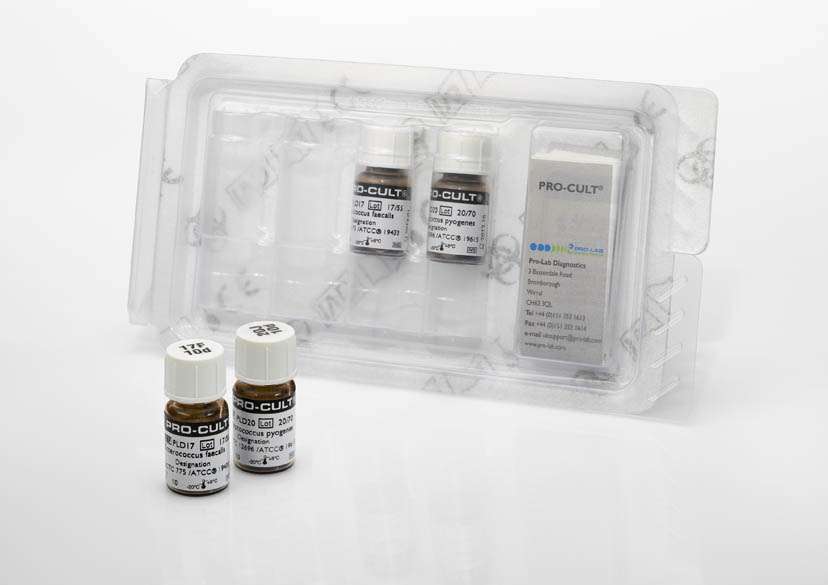
Pro-Cult is sourced exclusively from NCTC® and NCPF® (UKHSA Culture Collections) under a manufacturing licence held by TCS Biosciences Ltd, while Microbiologics products are sourced from ATCC. Each Pro-Cult disc is a first-generation subculture from the master strain (P1); Microbiologics LYFO DISK is delivered within four passages of the ATCC seed (≤P4). Both ship refrigerated at 2–8 °C as UN3373 Cat. B.
NCTC 12241 is the CLSI M100 / EUCAST QC reference strain equivalent to ATCC 25922. Pro-Cult supplies it as a freeze-dried 10-disc vial. The ATCC equivalent is listed on every Pro-Cult label and per-lot COA where one exists.
Yes. Pro-Cult organisms include the CLSI M100 reference strains by NCTC equivalent — E. coli NCTC 12241 (≡ATCC 25922), S. aureus NCTC 12973 (≡ATCC 29213), P. aeruginosa NCTC 12903 (≡ATCC 27853), E. faecalis NCTC 12697 (≡ATCC 29212), K. pneumoniae NCTC 13368 (≡ATCC 700603) — and CLSI M100 footnotes accept equivalent reference strains. Document the equivalence in your SOP.
Yes. EUCAST QC reference strain tables explicitly list NCTC numbers alongside ATCC numbers for routine AST QC, making Pro-Cult a direct match for labs running EUCAST methodology.
Up to four. Per the Pro-Cult Insert Issue 10 (Limitations section), a Pro-Cult disc is itself the first-generation subculture from the NCTC/NCPF master, and no more than four further passages from the Pro-Cult working stock should be made — keeping total passages from the master to the recommended maximum of five before genetic drift becomes a risk.
Every batch is tested for identification and characterization attributes in UKAS-accredited Lab #2496. A per-batch Certificate of Analysis is available online via the TCS Biosciences COA portal — search by Code, Lot Number, Strain, or Strain Designation. UKAS accreditation is independently verifiable at www.ukas.com.
Pro-Cult ships refrigerated as UN3373 Category B Biological Substance (no hazmat surcharge). Store at the temperature indicated on each SKU's label (most strains: 2–8 °C). Allow the vial to reach room temperature before opening, replace the cap immediately after each disc removal, and do not use discs past the labeled expiry date.
Yes. We provide a 30-day parallel-run SOP template that you run alongside your current QC reagent against the same media and AST plates. Equivalent phenotype across the parallel run is the switch criterion. SOP addenda only need to add the NCTC↔ATCC equivalence line; tech retraining is typically under 30 minutes.
Two cases: (1) when your method explicitly requires an ISO 17034 Certified Reference Material — Pro-Cult is an authenticated culture under ISO 13485, not a CRM, so source from an ISO 17034-accredited supplier; (2) when a regulatory submission cites the origin-of-record ATCC strain by ATCC number — use the ATCC genuine culture for that filing. For routine clinical micro, food, water, and most pharma method QC, Pro-Cult is fit-for-purpose.
“Pro-Cult® discs are intended for use in microbiological laboratories for the control of test methods. Being 1st generation derivatives traceable to recognised culture collection strains, Pro-Cult® discs are acceptable in accredited laboratories for the production of working stock cultures.”
Source: Pro-Cult Insert Issue 10 (Sept 2019), English Intended Use, page 1.
Principle: Pro-Cult® discs are freeze-dried microbial preparations manufactured exclusively from NCTC® (National Collection of Type Cultures) and NCPF® (National Collection of Pathogenic Fungi) cultures. The viability of the organisms is stabilised by the unique formulation of the disc. Each disc is a first-generation subculture from the master culture; rehydration in a recommended diluent or on appropriate solid media yields a viable inoculum at a known starting concentration suitable for QC of culture media, biochemical identification, antimicrobial susceptibility testing, and molecular workflows.
Solid media — direct plating: Place a Pro-Cult® disc on the appropriate solid medium using sterile forceps or a sterile 10 µL inoculating loop. Allow the disc to soften for 10–15 minutes (the plate may be placed in an incubator to accelerate). Spread the softened disc around the plate. Incubate under optimum conditions for the strain.
Liquid media: Place the disc in 1–10 mL of the appropriate broth. Avoiding aerosols, shake the broth gently to dissolve the disc. Incubate under optimum conditions.
Rapid use: Dissolve the disc in 1–10 mL of appropriate broth, allow the culture to recover by incubating at 35–37 °C for 1 hour, then use immediately.
“Repeated subculture can cause the characteristics of a strain to change. A Pro-Cult® disc is a first generation subculture from a master culture sourced from Public Health England Culture Collections, and is designed to be used to obtain working stock cultures for use in testing. It is generally accepted that no more than five passages (successive subcultures) should be made from the master culture, in order to avoid genetic drift and mutant selection. Therefore, no more than four passages from the Pro-Cult® working stock culture should be made.”
Source: Pro-Cult Insert Issue 10, Limitations section.
Pro-Cult is a biological-only product (no hazardous chemical components, no GHS classification). Most clinical-relevant strains in the line are Risk Group 2 — BSL-2 containment is required.
“Pro-Cult® batches are tested for a range of identification and characterisation attributes in UKAS accredited testing laboratory number 2496. A test report (Certificate of Analysis) for each batch of Pro-Cult® can be accessed via the TCS Biosciences Ltd website. The reporting of the test results via the website forms part of the UKAS accreditation.”
Source: Pro-Cult Insert Issue 10, Quality section. Verify Lab #2496 at ukas.com.
Per-SKU pricing for 1–9 / 10–49 / 50+ vials. Ships from US fulfillment as UN3373 Cat. B refrigerated.
Per-SKU pricing for 1–9 / 10–49 / 50+ vials — back to you in 1 business day. GPO match available on equivalent SKUs.
Get a QuoteShips from US fulfillment — most in-stock SKUs ship next day. Refrigerated, UN3373 Cat. B.
Add Starter SKUs to Cart15 minutes — switching SOP, GPO match, IQCP planning, or pharma USP fit. With a Pro-Lab specialist.
Book a CallPro-Cult® Insert Issue 10 (Sept 2019) and a sample UKAS Lab #2496 Certificate of Analysis.
Download Insert